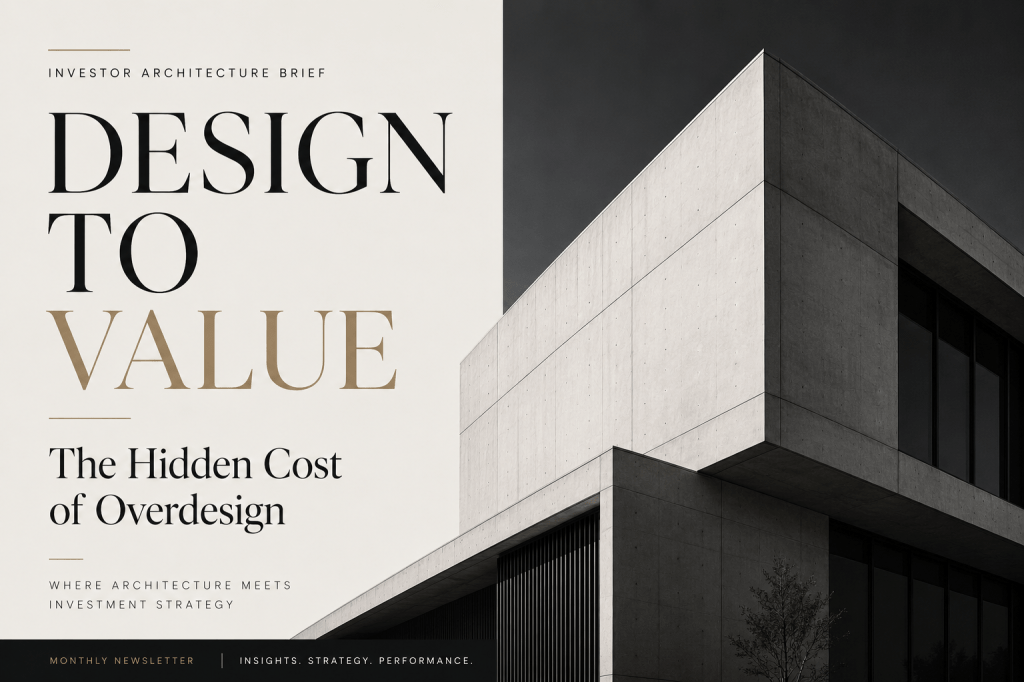
There is a common assumption in real estate development that “more design” automatically creates more value. In reality, some of the most financially fragile projects I review are also the ones trying the hardest to look impressive.
Over the past few years working in private lending, I’ve reviewed everything from small DSCR refinances to ground-up construction projects. One pattern continues to repeat itself: complexity often increases risk faster than it increases value.
That does not mean good design is unnecessary. It means design must remain aligned with execution, financing, timelines, and long-term usability.
According to reporting from CBRE Research and multifamily market analysis from JLL Research, efficiency and functionality continue to outperform excess in many residential asset classes. Investors are increasingly prioritizing layouts, durability, operational efficiency, and flexibility over unnecessary architectural complexity.
From the lending side, overdesign creates problems faster than many investors realize.
I’ve seen projects with oversized glazing systems, complicated rooflines, expensive façade treatments, and highly customized interior layouts struggle to stay within budget long before construction is complete. In many cases, the additional cost does not translate proportionally into appraisal value, rent growth, or resale performance.
The issue becomes even more visible during underwriting.
Lenders naturally look for predictability. Projects that feel overly complicated tend to raise more questions:
- Is the budget realistic?
- Can the contractor execute efficiently?
- Are timelines achievable?
- Will the finished product actually support the projected exit strategy?
Sometimes the strongest projects are surprisingly simple.
A well-designed floorplan with efficient circulation, balanced natural light, durable materials, and strong functional planning often performs better financially than projects attempting to maximize visual impact at every corner.
This is especially relevant in investor-focused residential projects. Most tenants are not paying premiums for architectural ego. They respond to comfort, usability, storage, natural light, parking convenience, privacy, and layout functionality.
That distinction matters.
One of the biggest misconceptions in development is confusing expensive with valuable.
Good investor-focused architecture is not about removing creativity. It is about directing creativity strategically. The goal is not to design the most complicated building in the room. The goal is to create spaces that perform well financially while still delivering a strong user experience.
Personally, I think the future of small-scale development belongs to projects that combine intelligent design with disciplined execution. Not cheaper design. Smarter design.
That balance is where architecture becomes truly valuable.
Alanna Avalone — Private Lender
Call/ Text/ WhatsApp: +1 (305) 537-6443
This newsletter is my weekly take on lending, markets, and mindset, from someone who still loves helping people get deals done.
Thanks for reading!






 Alanna Avalone
Leave a comment